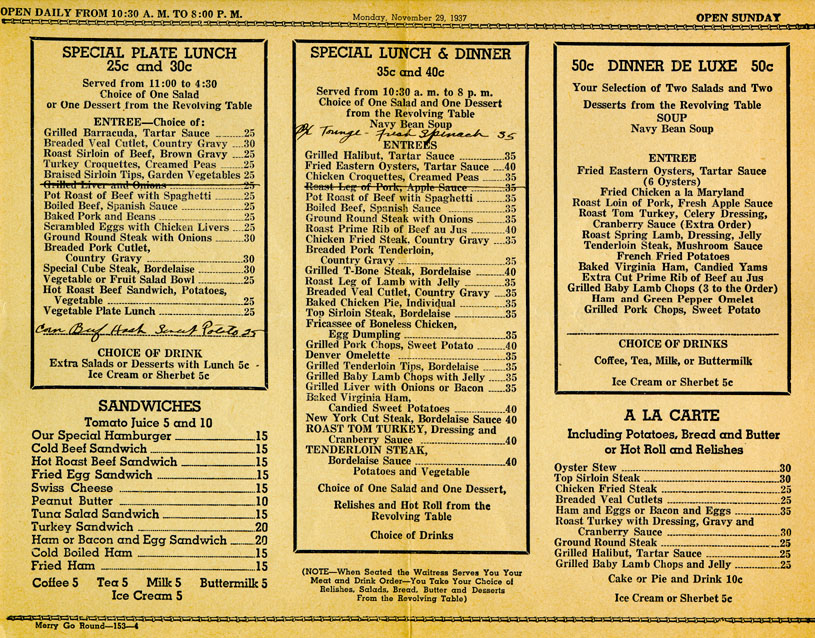
HOW EXPENSIVE WAS IT TO GO OUT TO EAT IN THE 1930S?
1930 A survey by the U.S. federal government determines that 38 cents is the average amount paid for lunch in big city commercial eating places across America.
Here are some examples of prices:
1931 Schrafft’s was a chain of moderately priced restaurants along the East Coast. This menu was for the one on Flatbush Ave., NYC: Special Green Vegetable Dinner, 75¢; Minute Steak, $1.25; Chicken Salad, Home Style, 90¢.
1932Pig ‘n Whistle, Los Angeles: 75¢ businessman’s lunch of Charcoal Broiled French Lamb Chops, New Peas, French Fried Potatoes, Fruit Salad, Hot Biscuits, and Coffee, Tea, Milk, or Tomato Juice.
1934 On its August 15 menu Mary Elizabeth’s, a tea room on Fifth Avenue at 36th Street in New York City, offers a Tropical Chicken special with Orange Sections, Pineapple Hollandaise, and New Green Peas for $1.10. A Cream Cheese and Jelly Sandwich is 30 cents, while Iced Watermelon is 20 cents.
1937 Toffenetti’s Triangle Restaurant in the Chicago Loop: “…lean, savory, juicy Hamburger sandwich, With a white crisp slice of Bermuda onion, With a beautiful slice of tomato, With a dessert, With a beverage … All for only 30¢.”
1939 Lunch at a Woolworth’s counter: “Today’s Feature Luncheon 25c – Cubed Minute Steak, Panned Gravy, Sliced Buttered Beets, French Fried Potatoes, Hot Cloverleaf Roll and Butter.”
As you may notice, most of the foods served in these moderately priced restaurants are fairly standard American fare. French and Mexican cuisine was sparse. But I sure would not go out to a tea room in Manhattan to purchase a cream cheese and jelly sandwich!
So, when my heroines in my WIP go out to a diner for coffee (@ $.05) and a scone (@ $.10) and leave two quarters as payment, they left a big tip! 40%!
Even the high prices at the biggest dance studio/restaurant in Boston, the Cocoanut Grove, was a pittance at fifty cents a drink for a standard Manhattan or martini. Of course, the glasses were a little smaller back then. A steak dinner could be had, there, for just over a dollar. And that included sides.
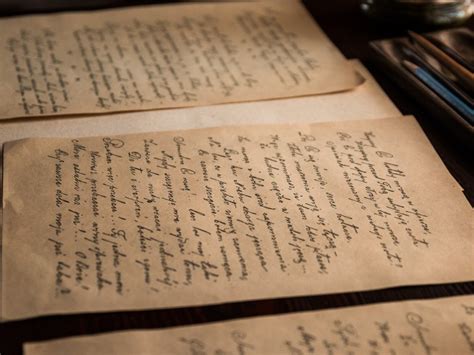
In the latest Hadley Sisters Mystery, a very old, very faded document is found in a 25-year-old used book. It looked like a list. I utilized a bit of real history, here, being the history buff that I am. So, here is the real story behind the fiction document:
Massachusetts Bay Colony was settled very quickly in the 1630s and 1640s. 700 immigrants came in 1630 alone, 16,000 by 1636. Education was a primary requisite of the new Puritan village. In 1635, the first public school was established. Boston Latin School was opened to young boys. With a need for clergy, a year later, the Great and General Court of the Massachusetts Bay Colony voted to develop the College at New Towne (now known as Cambridge). First, they had to survey the land for the town, then find suitable property to purchase within the land for a college. They found an established farm that was being abandoned by its owner.
A young, energetic man, Nathaniel Eaton, who had had several years of teaching experience, arrived in June 1637. He came with his older brothers, Theophilus, former ambassador to Denmark and successful merchant, and Samuel, a Pilgrim minister. These two men were well known men of morals. They recommended their brother to be the professor/headmaster of the new college.
Nathaniel helped organize the school in the months before he moved in. He established an apple orchard, supervised the extension of the house and managed to get a printing press delivered half way through the first year. Being the new schoolmaster, he would have hired the employees, maids, servants and school assistants. He would have done the teaching of all the classes for the estimated nine to twelve boys who were enrolled. There were several teacher’s assistants to help with correcting the papers and other academic work.
By default, Mrs. Eaton was in charge of the feeding of all the students and employees of the college, as well as directing the day-to-day schedule on the farm and in the school. She also had several small sons, and taking care of her children would have been a big part of her day.
Nathaniel’s friendship with John Harvard, who lived in Charlestown, helped solidify the future of the college. Harvard died in early fall, 1638, at the same time that the doors opened for the first time. He left the school 779 pounds sterling and his entire library of four hundred books, thus setting the basis for having the school named after him in March 1639.
In the end, the fictional document was a list of required items needed by the new headmaster of the college to make the place run efficiently. The theory was that the document was left to an early family member, who passed it down, without much concern as to its historicity. It made for a good story, anyhow.
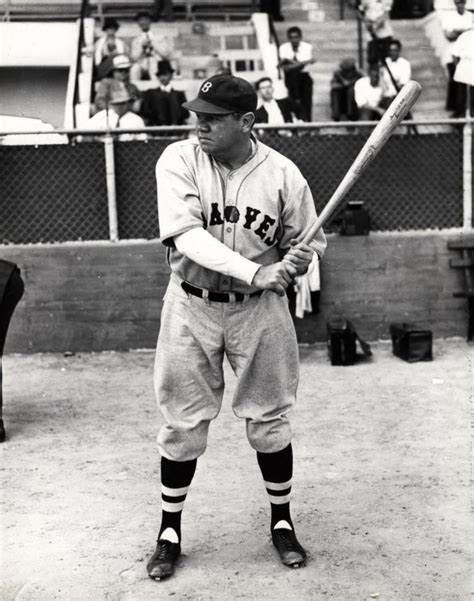
Babe Ruth, from the archives of the New York Times
Here are some of the literary, entertainment and political bits from 1935. This was the official beginning of the “Golden Age” of Hollywood and the year people realized that Hitler was dangerous.
January 1….The first Sugar Bowl! Tulane won 20-14.
First week in January Goodbye Mr. Chips by James Hilton had been on the NYT Bestseller list for half of its half year run.
January18 The release of “David Copperfield” starring Freddie Bartholomew, as David, Basil Rathbone as the evil step-father, W.C. Fields in a serious role as a down and out drunk, Maureen O’Sullivan as Dora. This was one of the top billing movies of the year.
Also in January…. Another top billing movie released that no one knows about. “The Lives of a Bengal Lancer” starring Gary Cooper, Franchot Tone, Richard Cromwell, Guy Standing and Douglas Dumbrille.
February 6 Charles Darrow began to sell the Monopoly game. He later sold rights to Parker Bros. and became a millionaire in his own right.
The first week in February, “The Forty Days of Musa Dagh” by Franz Werfel was in the top ten best seller book list.
February 15 “Lovely to Look At” recording by Eddy Duchin and his orchestra was released.
February 28…. The first nylon polymer was manufactured. Little did anyone realize how important that would be within a decade.
March 9 Hitler announced creation of the Luftwaffe, the German Air Force.
First week in March, the book, “So Red the Rose” by Stark Young was in the top ten best seller book list published weekly by NYT.
April 1 The first radio tube made of metal was announced.
First week in April “Come and Get It” by Edna Ferber hit the top ten books according to NYT.
April 14… Severe dust storms covered the US Midwest, destroying crops.
April 19…. “The Bride of Frankenstein” was released. It starred Boris Karloff, Colin Clive, Valerie Hobson and Elsa Lancaster.
April 20 “Go Into Your Dance” was released. “She’s a Latin from Manhattan” was a single that hit the top of the charts, sung by Al Jolson.
First week in May, “Green Light” by Lloyd C. Douglas hit the top ten book for that week.
May 30 Babe Ruth played his last game for the Boston Braves and retired on June 1.
In the first week of June, Thomas Wolfe’s book “Of Time and the River” made it to the NYT Bestseller list.
June 10 Alcoholics Anonymous informally began with Dr. Bob and Bill and spread quickly all over the world.
“When I Grow too Old to Dream” by the Glen Grey Orchestra was heard on the radio. It was reprised often over the next 25 years.
In the first week of July, Rachel Field’s “Time Out of Mind” was on the best seller list.
July 31 The first Penguin Publishing Company book was sold. The paperback revolution was on!
One of August’s best-selling books was “National Velvet” by Enid Bagnold. After the war, it was made into a movie with Elizabeth Taylor.
August 14 The Social Security Act was passed into law.
August 25 The movie, “Broadway Melody of 1936” opened. The stars all went on to have great careers in Hollywood: Jack Benny, Eleanor Powell, Robert Taylor, Sid Silvers and Buddy Ebsen.
September 6 “Top Hat”, the musical movie starring Fred Astaire and Ginger Rogers was released. One song from the movie, “Cheek to Cheek”, sung by Astaire, was the number one song of 1935.
“Paths of Glory” by Humphrey Cobb was on the NYT bestseller list.
September 30 The Boulder Dam (later renamed the Hoover Dam) was dedicated by Franklin D Roosevelt.
“Lucy Gayheart” by Willa Cather was on the NYT bestseller list for weeks in October.
October 20 Mao Zedung rose to prominence after the communist Chinese march to Yan’an China that ended this day.
“It Can’t Happen Here” by Sinclair Lewis was a best-selling book according to the NYT.
November 5 The Maryland Court of Appeals ordered the University of Maryland to admit Donald Murray, a black student.
November 8 “Mutiny on the Bounty”, a movie about a real mutiny, was released. It starred Charles Loughton as Captain Bligh and Clark Gable as Mr. Christian.
“Europa” by Robert Briffault was on the NYT best-seller list in December.
December 10 The Nobel Prize in Chemistry went to Irene Joliot-Curie and her husband Frederic Joliot for the discovery of artificial radioactivity. A day later, the Nobel Prize in Physics went to James Chadwick for the discovery of the neutron. These two discoveries would change the world in ten years.
December 31 “Red Sales in the Sunset”, a popular song, became a staple of Guy Lombardo’s Royal Canadian Orchestra.
Of the top 100 songs for 1935, seven were written by Irving Berlin and six were song by Bing Crosby. They were two very popular men that year!
Available in ebook and paperback at Amazon https://www.amazon.com/Matter-Misplaced-Document-Sisters-Mysteries/dp/0983975833/ref=sr_1_7?dchild=1&keywords=Elizabeth+Martina&sr=8-7
Originally published at https://www.commdiginews.com/history-and-holidays/jamestown-yorktown-remembering-the-women-and-black-soldiers-who-founded-america-123784/
The ship, Mary and Margaret, landed in Jamestown September 30, 1608. It was part of the second supply, bringing supplies and more settlers to the new settlement of Jamestown. On board were Thomas Graves, gentleman, his friend Rawley Crowshaw and Mr. and Mrs. Thomas Forrest. With the Forrests came Mrs. Forrest’s lady’s maid, Anne Burras (Burrows). A John Burras was abroard, also. He may have been an older brother to keep an eye on his young sister in her first job. The couple had not been married very long, only about three years. There is no indication of children. Mistress Forrest apparently got sick on the journey. Anne was responsible for caring for her employer.
The fort at Jamestown was small at best, covering about 1 acre of land. The houses and the church were shoddily built. The first shipload of men did not believe they would be staying very long, so they threw up poor shelters. There was no where nice for Mistress Forrest to be as she fought her illness. She died within a month or so of arriving. Fourteen-year old Anne was unemployed. The only female among over one hundred men, most unmarried, Anne had the attention of all the inhabitants.
Only two or so months after landing, Anne found a man she could be comfortable with and married John Layton. John was a laborer who was twice her age. They had the first child to survive in the New World in December 1609. And they named her Virginia. At that point, they moved to a small outpost closer to the ocean called Point Comfort. It was fortuitous. For that was the winter of the Starving Time. Those stuck within the fort were unable to get out for months due to Indian attacks. Their food supplies did not hold out. Point Comfort had no Indian attacks and the salt water nearby had plenty of seafood.
They and their growing family survived. During the next few years Alice, Katherine and Margaret joined their older sister.
The family next survived the Good Friday massacre in March 1622. They then moved a little further away from the James River, residing in Elizabeth City (now Newport News) by the muster of 1624. At this point, John had begun to accumulate patents of land. In the muster, it was indicated that he had 100 acres on the east side of Blunt Point Creek, in lieu of 100 acres on the island of Henrico. This city became less favorable after the massacre.
In 1636, John and Anne’s brother, Anthony Burrows, patented 1250 acres near Elizabeth City. They had become moderately prosperous by the 1630s. But even prosperous people could not fight the poor quality of life at that time. It is assumed that Anne died sometime in the mid 1630s.
Available in paperback and ebook at Amazon. amazon.com/Matter-Misplaced-Document-Sisters-Mysteries/dp/0983975833/ref=sr_1_11?dchild=1&keywords=Elizabeth+Martina&qid=1605059568&sr=8-11
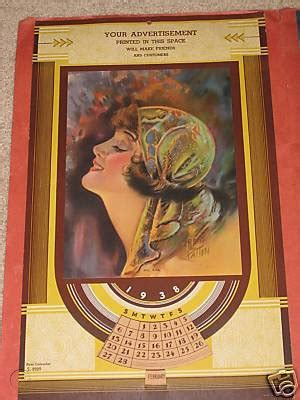
WHAT MADE 1938 UNIQUE? Let's look at some of the events, movies, books and songs of that year.
JANUARY
March of Dimes began
Benny Goodman made jazz legitimate by playing at Carnegie Hall Jan 16
Madame Curie, by her daughter, Eve Curie, was released in 1937 but made #1 on the NYT Bestseller list around New Years
FEBRUARY
The second Sino-Japanese war began
First nylon bristle toothbrush was developed
Snow White and the Seven Dwarfs released
Northwest Passage, by Kenneth Roberts, was #3 on NYT Bestsellers List
MARCH
German troops annex Austria
Jezebel, starring Betty Davis and Henry Fonda, an antebellum drama, was released
The Yearling, a coming of age story by Marjorie Kinnan Rawlings was @2 on NYT Booksellers List
APRIL
Superman comics were released for the first time
Adventures of Marco Polo starring Gary Cooper and Basil Rathbone was released. This was the most elaborate and costly of Sam Goldwyn’s productions.
Joseph in Egypt by Thomas Mann his #3 on NYT Bestsellers list
MAY
The Vatican recognized Franco’s Spanish government, despite the continued civil war
Adventures of Robin Hood was released, starring Errol Flynn, Basil Rathbone, Olivia de Haviland, and Claude Rains
The Rains Came, by Louis Bronfield, ranked #3 on the NYT Bestsellers List
JUNE
The ballpoint pen was patented in England
Three Comrades, starring Robert Taylor, Margaret Sullivan, Franchot Tone and Robert Young, was released. It was a historical fiction about the Weimar Republic.
Parts Unknown, by Frances Parkinson Keys, was #4 on NYT Bestsellers List
JULY
The conference on refugees convened in France. No European country was willing to accept Jewish refugees. The US would only accept 27,370.
Marie Antoinette, a movie starring Norma Shearer, debuted.
The Mortal Storm, by Phyllis Bottome was #3 on NYR Bestsellers List
AUGUST
Germany spent two months threatening to invade Czechoslovakia before doing so in October
Four Daughters, a musical comedy, was released.
How to Win Friends and Influence People by Dale Carnegie was still selling well, over a year after its release.
SEPTEMBER
European countries were changing their stances regarding Germany. America stayed neutral.
You Can’t Take It With You was a popular comedic movie/
The Evolution of Physics, by Alfred Einstein, was still selling well after hitting #1 on NYT Bestsellers list in May.
OCTOBER
12,000 Polish Jews were expelled from Germany. Only 4000 were allowed into Poland. The other 8000 had to live on the No-Mans Land at the border.
The movie, Young Dr. Kildare, starring Lew Ayres and Lionel Barrymore, was released. This was the first of nine Dr. Kildare movies in a series.
Rebecca, by Daphne du Maurier, was #6 on the NYT Bestsellers List
NOVEMBER
The union, the Congress of Industrial Organization (CIO) was formed.
If I Were King, a historical drama starring Ronald Colman, Basil Rathbone and Frances Dee was released.
All This and Heaven, Too, by Rachel Field, was #2 on the NYT Bestseller list.
DECEMBER
Otto Hahn discovered nuclear fission of uranium, the basis of nuclear power. The Nuclear Age begins.
Sweethearts, a musical starring Jeanette MacDonald and Nelson Eddy, was released. These two were a very popular singing duo.
Listen! The Wind! By Anne Morrow Lindbergh, released on 10/20 is on the NYT Bestseller List.
SONGS HEARD THIS YEAR:
And the Angels Sing
At Long Last Love
Change Partners
I can Dream, Can’t I
Jeepers Creepers
Begin the Beguine
The Americans were celebrating a return to normal life, after the Depression had done its worst. They were being entertained with comedy and music. And they were trying to stay innocent.
Available in ebook and paperback at Amazon https://www.amazon.com/Matter-Misplaced-Document-Sisters-Mysteries/dp/0983975833/ref=sr_1_7?dchild=1&keywords=Elizabeth+Martina&sr=8-7

Recent Comments