Hitler invented the Bllitzkreig to invade Norway, Denmark, the Netherlands, Luxembourg and France. London was bombed for months. The US government opposed Hitler's aggression but would not get involved. Soon, however, they began to help Britain with supplies. The climate improved in the US and the harvest was better than in years. The first peacetime draft began In the summer.
Movies from 1940:
Gone With the Wind won Academy Awards.
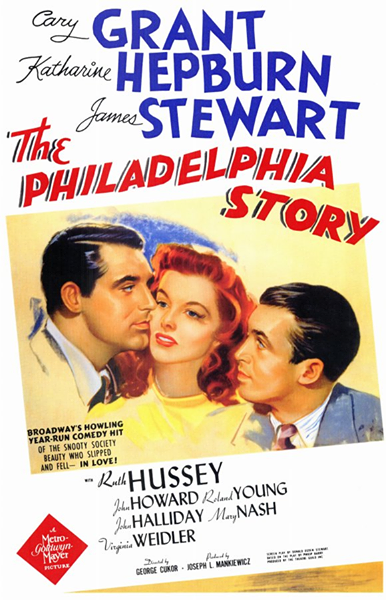
The Philadelphia Story starring Cary Grant, Katherine Hepburn and James Stuart.
Seahawk, the swashbuckling movie with Errol Flynn
Mark of Zorro with Tyrone Power, Linda Darnell and Basil Rathbone
Writer first, family second? No. Not me. I keep thinking I can do both equally. Actually, I think I can wear a half dozen hats at all times. This is not possible, however. At least, not until I can clone myself or acquire the gift of bilocation, a gift I would only share with a half-dozen other people throughout history.
So, barring those two options, how am I supposed to get everything done? Extreme organization comes to mind. But, what are the exact steps to take in organizing a life that includes working the main job, writing books, maintaining the house, gardening, a prayer life and a few side jobs. I am of the opinion that extreme organizing is necessary for those who want to wear many hats.
It is a matter of self-discipline. And it is a pain in the neck to develop. But it works for those who want to wear all those hats. You must know your limits, how much you can handle at one time. You need to be able to take each day as a separate entity, within a larger goal structure.
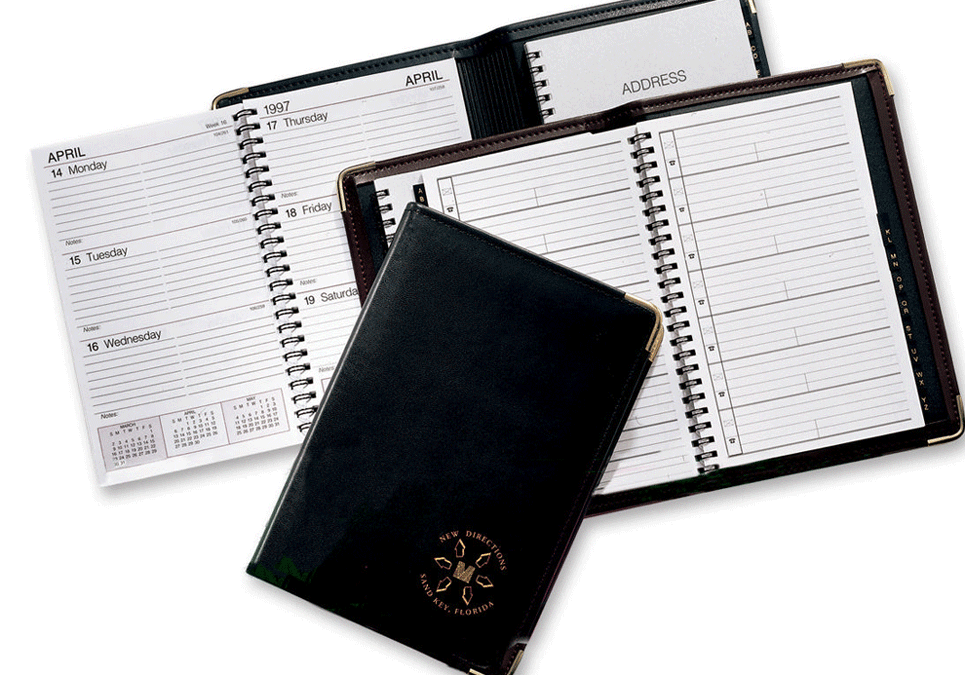
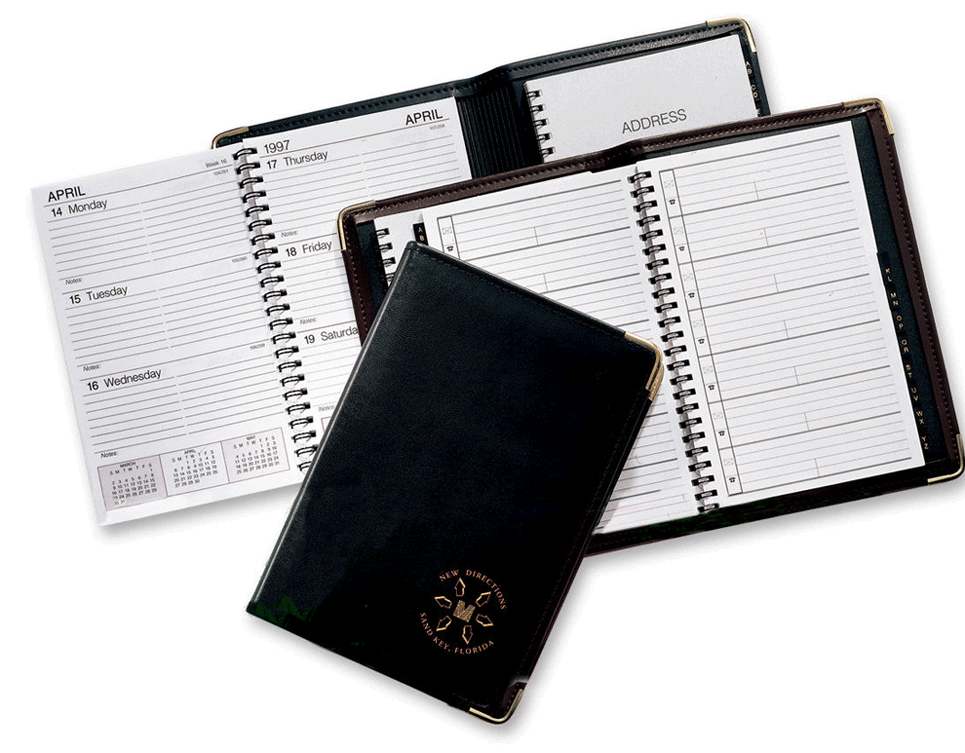
I had to design my own organizer. And I put it on my desk opened to the current day. I have two weekly pages, divided into goals and each day’s assignments. The goals are subdivided into business, writing, personal and financial. There is space for three of each type of goal for that week. The days’ assignments are divided into “morning”, “afternoon” and “evening”. On succeeding pages, I have 1 page for each business day and 1 page for the weekend. Each page is divided into 6 squares, labelled “reminder”, “priorities”, “scheduled events”, “accomplishments”, “be grateful for” and “follow up”. Then I check off the list of things to do, say, buy, or whatever, during the day. By the end of the day, all the things I have yet to do get entered in the “follow up” section. I am not sure which I am better at: not filling my “to do” list too much or ignoring what I haven’t done yet. I often do not enter there. But at the end of the day, I make sure I record what I am grateful for. It is often my husband, who is so accommodating.
“Reminders” include what I did not accomplish the day before and my grocery lists, usually a pretty short list since I shop weekly, making sure to buy things that we are getting low on, even though we are not yet out. The “priorities” tend to be items like exercise, listen to a specific audio tape, or remind me of my diet. The “scheduled events” are typically the items recorded on the weekly pages. “Accomplishments” are a report to myself of what actually got done, although I sometimes just put checkmarks next to what was listed.
Since I am ADD, I tend to not do the same thing for a whole day. I give myself so many hours to do a blog, or clean the house, for example. Hence, the division on the weekly sheets into morning, afternoon, and evening.
I am still working on this organizer. So far, there isn’t a spot for reading, so it is relegated to times when I am riding in the car (not driving) or brushing my teeth. It’s a work in progress.
Any suggestions to be able to juggle my life and my organizer are cheerfully requested!
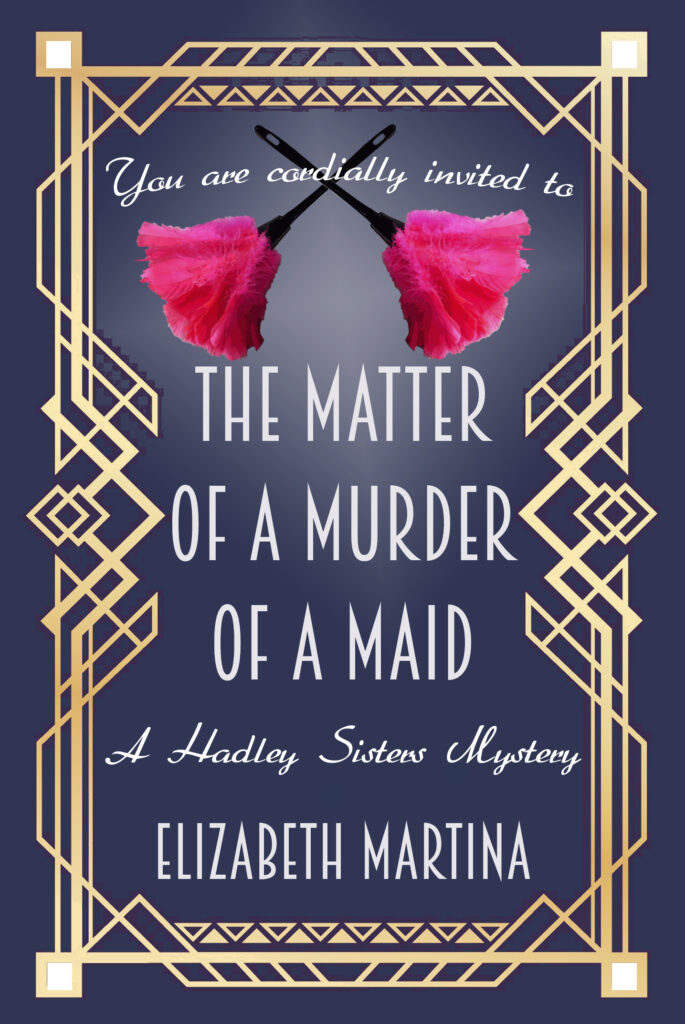
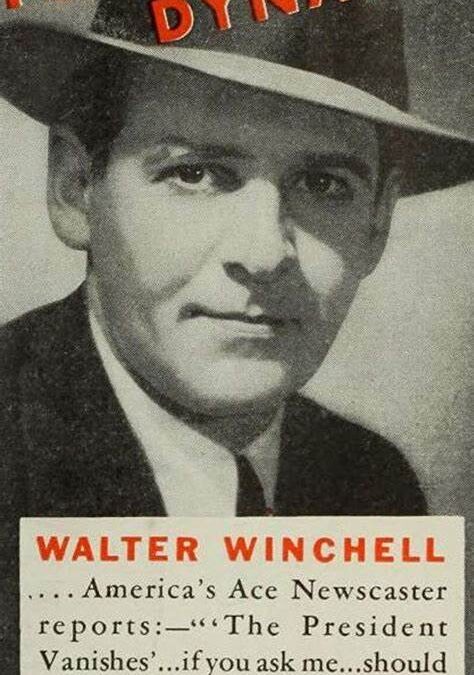
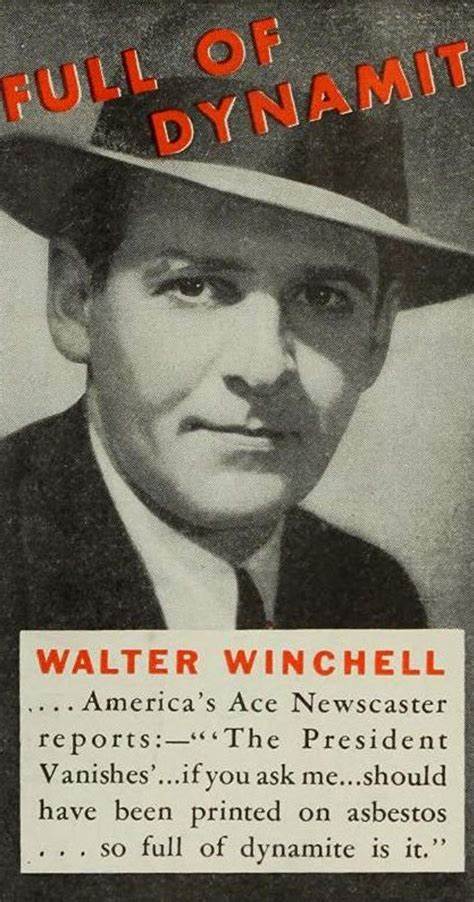
In my book, The Matter of a Missing Stutz, a Harvard professor and his wife are so intent on listening to the radio broadcast of Walter Winchell, that they don’t hear their new car being stolen. Who was this Mr. Winchell and why did his radio broadcast mean so much to them that they didn’t even hear the engine of the car start?
The 1920s and 1930s were a time of complete cultural change. Dresses moved from ankle-length to just below knee. Men’s faces became hairless. Newspaper publishing was at its peak, but soon to give way to national broadcasts 24 hours a day. Pianos in every home became silent as the radio music filled the houses. And house parties played second fiddle to the movie matinee.
Electronic entertainment was thrilling. There was something new every few hours all day long. Parlor seating was rearranged to get in close to the entertainment center. That was a radio. In the years before the war, this usually meant a furniture sized cabinet with speakers built in and three knobs prominently placed. One was the on/off switch. One was the volume switch and one was the channel changer, sitting below a window showing where on the dial you were tuned to.
Shows were anywhere from 15 minutes to 30 minutes in length, including the commercials. For anyone who could afford a radio, there were a variety of shows. Comedy, drama, crime stories, gossip (all the dirt on your favorite politicians and actors!) and news commentary vied with orchestras for attention. And the attention was not only for the actors and actresses but also for their sponsors (nothing has changed in 100 years!) The sponsors of many of these broadcasts were companies who sold every day household items, soaps, cold creams, cigarettes and, later, food products.
Walter Winchell was different. He didn’t have a show, he had a following. In the 20s, his newspaper column was read by 50 million a day. He worked for several radio stations, starting with CBS in 1930. He did a 15- minute business analysis and gossip of Broadway and moved to another radio station in 1932 where the same information was sponsored by Jergen’s. These shows went national as people were entertained by his innovative style of gossipy staccato news briefs, jokes and Jazz-Age slang.
By the middle of the decade, Winchell had seen enough of the underside of crime, reporting on the activities of the criminals, who also happened to be his friends. It got dangerous for him. So, he switched sides and started rooting for J. Edgar Hoover and his crime-solving capacity. Soon enough, he started to see how Hitler was destroying Europe and joined that bandwagon to condemn Germany and the isolationists of America. Being Jewish, himself, this disaster was dear to his heart. During the war, he supported the president and insulted the president’s enemies.
Later, he claimed he could speak at 200 words a minute, delivering the news so quickly, that people had to pay very strict attention. With the quality of the transmissions being what they were 80 years ago, and his voice being the unique type that it was, we can assume that the professor and his wife would not have been able to concentrate on Mr. Winchell’s news and the neighborhood noises at the same time.
Curls were in in the 1940s. Pin curls, roller curls, brushed into place curls. Women could make them, artificially if need be, and men might be blessed with them.
Men were clean-shaven, their hair short. Parts were common. The pompadour was still around, but not as popular as it would be in the 50s. Curly hair was worn slightly longer on top so it could be swept up and worn wavy at the top of the head.
Women’s curls were big! They were achieved with pins or rollers, and any combination of chemicals that kept them looking good. Longer hair tended to be in vogue because, with so many women working, there was not enough time, or, honestly, money, to keep the short do at prime length. But the hair needed to be kept off the face for factory and office work. Plus, it was patriotic to not spend a lot of money when our boys were away fighting for our lives.
Turbans and head scarves were popular. They both achieved the same end, keeping the hair out of the way. The scarves were often multicolored and tied at the top of the head, where the knot was center of attention. The forehead was decorated with small curls or bumper bangs. More on that last one, later.
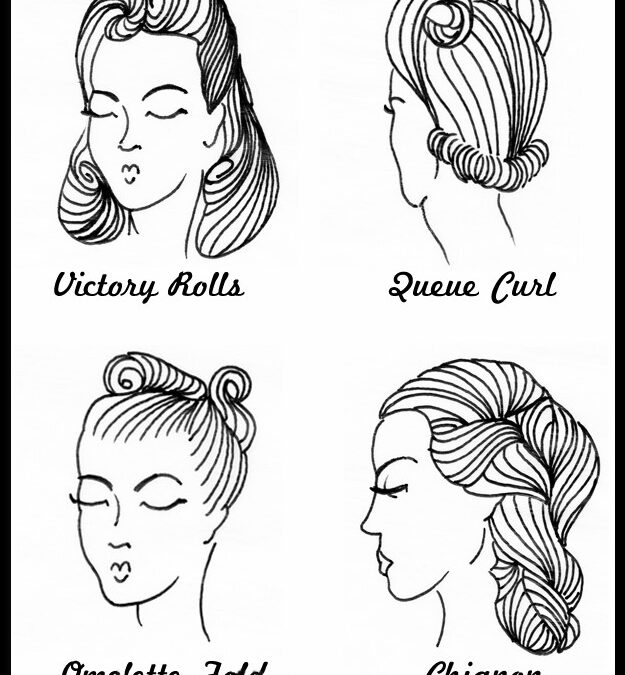
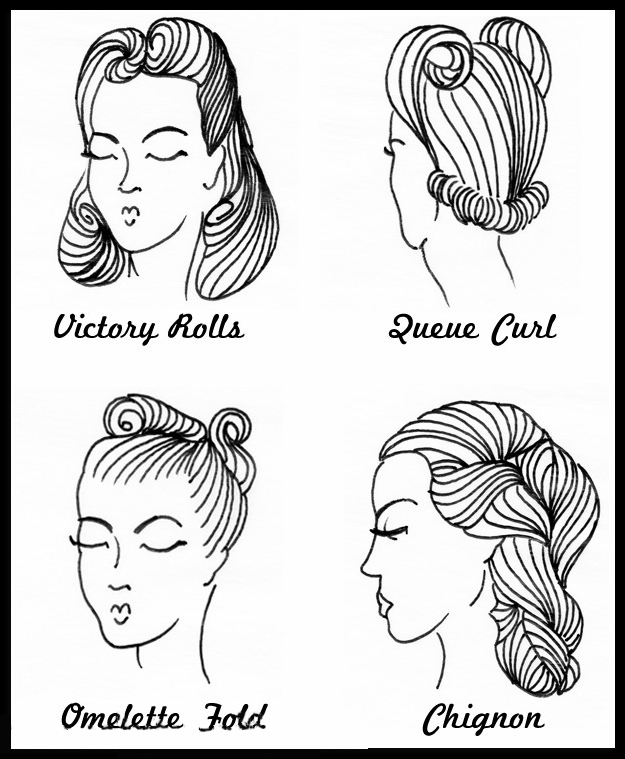
The ultimate show of patriotism seemed to be the Victory curls. These were big sausage sized curls kept in place with plenty of spray and pins. They were the ultimate pinup girl’s hairdo. Remember Betty Grable? These curls were worn piled on top of the head or pulled back and made into a roll at the nap of the neck. Sometimes both at the same time.
For those without the time or inclination, there was the hair snood. It was a loosely knit (or crocheted) item which took in all the hair (usually loose tresses) up to the crown of the head. The hair was seen through the loose stitching, but held away from shoulders and face.
For the lady who had the time, there was the omlet fold. Hair was parted in the middle, all hair on one side was rolled into a huge curl towards the part. The back was done in a variety of ways. This took patience.
For very long hair, or fake hair, there was the wrapped braid, a little country looking. It was not a big deal in the cities. Straight long hair could be worn long, with only the bottom curled, practically covering one eye, known as the peekaboo. Veronica Lake sported that hair style in several of her movies. Another look for quite long hair was barrel curls, a version of the Victory curl, but only at the ends of the tresses.
For medium length and shorter lengths, women could wear curls. Rollers worked for longer styles but pincurling wet hair and sleeping on it was quite common for the short styles. In the morning, all the woman had to do was take the pins out and fluff or comb. Page boy styles, not as popular as they would become in the 50s and 60s, were designed for ear length straight hair.
For slightly longer hair that was too short for the Victory curls, wearing the hair up with small curls pinned in place was just as popular. The pompadour, reminiscent of the Gay 90s, came back in a modified style, lower on the crown than before. The trick was to grow very long bangs to get the bulk a lady needed for the look.
So, for man or woman, the 1940s tended to accent the curl, or at least, the curve of the hair. Very pleasing to the eye and a welcome softness to another-wise tough time.
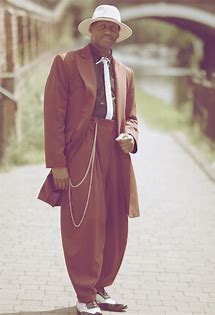
One of the outstanding features of the 1940s is the Zoot suit. These first appearing in the 1930s, but, by the 1940s they were associated with gangsters or rebellious young men. They were characterized by heavily padded shoulders, wide lapels, double breasted styling, long jackets (mid hip length), baggy pants with narrowly-circumferenced cuffed ankles. Suspenders were needed to hold up the pants. They came in vibrant colors, like purple. Since such a suit contained more material than rationing permitted, they were seen as unpatriotic. The colors were the opposite of the military look. On the east coast, a tie and dress shirt were worn. On the west coast, the wearers sported an open collar. A modified version became popular in the late 40s and early 50s. With that outlandish outfit, men wore wide ties and big hats. You could identify the gangster type from a block away!
After the war ended, there was an excess of military surplus on the market. People bought them or copied them for civilian use. Items included trench coats, bomber jackets, knit undershirts, chino jackets, pea coats and aviator sunglasses. Machinery which had been updated to speed up the manufacture of uniforms was now used to turn out civilian counterparts. Casual clothes, especially the shirts, became welcome when the men returned from the front. There was no going back to stiff and formal.
Not every man worked in an office. There was a distinction between the men’s office clothes and working men’s clothes. Workmen, factory workers or gas station attendants, wore collared shirts and work trousers, usually made of cotton twill or gabardine. The pants had flat fronts with a single leg crease. Leg widths were narrower than dress pants. The whole ensemble was in basic colors, white, green, dark blue, brown. Work shirts were all very similar with soft, pointed collars, patch pockets on either side of the buttons, pleats in the back and larger armholes for greater mobility.
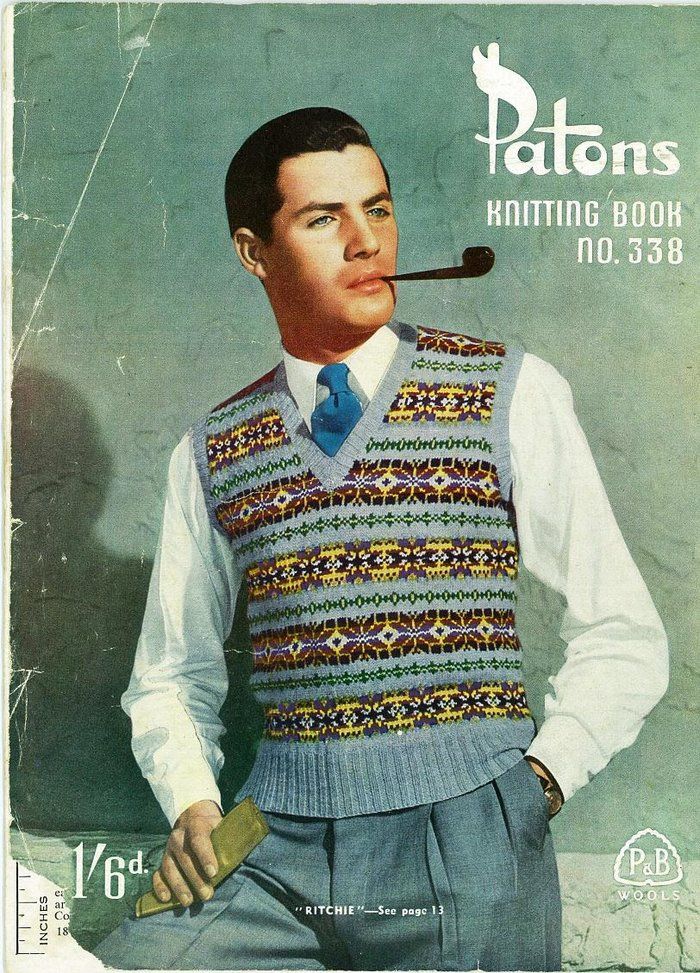
Casual and sport clothing became very popular after the war. Knit shirts, vests and pullovers were suddenly common for all age groups. They all had textured ribbed knits that were form fitting, with rib bottom edges, sleeve ends and neck bands. They came as high round neck or V-neck styles. They were seen in solid colors, with wide horizontal stripes or in Norwegian designs, especially around the winter holidays. Either the V-neck vests or long-sleeved versions would be worn over dress or casual shirts. Winter weight knits were in wool and summer weight were in rayon or cotton blends. This outfit was often worn with contrasting colors, deliberately.
Dress shirts turned casual for some occasions by having boxy sleeves and a straight cut at the bottom, so that they could look good not being tucked in. Often there were two chest pockets. They came in all sorts of colors, patterns. After the war, Hawaiian prints became popular as did Western styled shirts, boots and hats.
Casual trousers continued to look much like dress trousers, with lighter materials like wool blends for the cold, cotton poplin, gabardine or seersucker. The pants came in solid or patterned (ie herringbone, small check, tweed). The fun was in mixing shirt and pant colors. Sports coats, which had begun to show in the 1930s, became more popular with all sorts of patterns.
Outer wear was adapted from the military styles. Overcoats were knee-length, straight and boxy. They had wide peak lapels and side-angles slit pockets. Later in the decade, they were belted. Colors were typically tan, plaid, tweed or herringbone. The trench coat became vastly more popular than any other, whether it was the early single-breasted version or the belted double-breasted one. Every detective in every mystery movie wore one.
Men’s shoes were designed for quality, durability and sensibility. They included oxfords, wingtips, brogues and slip-on loafers, the later being more of a casual look. Brogues were a good choice for summer due to their decorative perforations through the leather, letting feet breath a little. Colors were limited to black, brown, white and two-tone, a male version of women’s spectators. For the working man, boots were of thick leather and soles, laced with hooks at the top.
The styles had definitely changed and, 70 years later, have not reverted.


Recent Comments