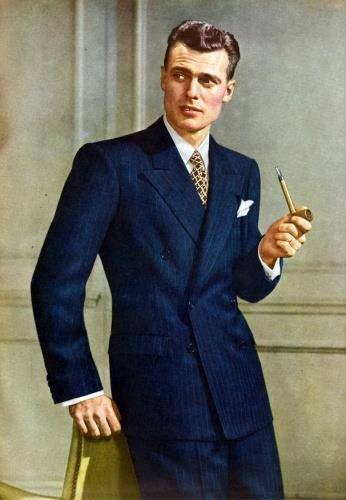
Men’s clothes seem to always be the same, at least in the past 100 years, you say. Well, I agree, up to a point. Suits can only have so many variations, of course. But the details are what make the suit. Variations of the details put the suit into or out of style. And, the 1940s, especially the later half of the decade, brought out a new concept: casual dress as a new style for adult men, not just teens and the university crowd.
In the 1930s, the style seemed to be “big”. During the war years, restrictions on fabric use meant that the men who stayed home had to do with more basic styling. Pockets on jackets could not have flaps. Trouser pants could have a maximum of 19” circumference at the ankle, and no cuffs. Suits without vests became the norm, being seen as “wasteful”. Cuffs being so popular, some men got creative, bought pants that were too long then brought them home to have a tailor cuff them. Emulating the ideal soldier, the men on the home front wore suits cut to make them look more muscular, masculine. Wearing older style suits was a badge of patriotism, saving the cloth for “our soldiers”.
In England, the restrictions were even harsher. No pleated back jackets or half belts, no raglan sleeves and no metal zippers or buttons.
For decades, men had worn suits for everything, from office to picnics. The suits tended to be made of thick wool, worsted wool or tweed. With the war, the wool was mixed with rayon to save more wool for the uniforms. It probably was a more comfortable suit. Winter colors were conservative: black, navy, grey, dark brown, tan, medium blue. Summer colors were lighter versions. Tweeds, herringbones, checks, plaids and wide chalk stripes were available.
Double breasted jackets were restricted during the war, so the new style suit coat was single breasted, only, for a few years. The war-time styling called for jackets to be tapered at the waist, with well-padded shoulders. Together with the wide notch or peaked lapels, it gave the illusion of a big man. When the double-breasted look came back, the men looked very big, indeed!
The suit trousers had either a flat or single pleat at the front. The waist fit high, with a 3” band. Suspenders were still de rigor, but, as the war ended and leather became more available, the pants became more fitted at the waist and belts with metal buckles became more popular.
Dress shirts now came with attached collars sporting large pointed tips. Shirts were one of the few colorful parts of a man’s dress. They appeared, mostly in cotton, in blue, white, tan, yellow, green and grey solids. Thin stripes and pin dots were also seen. They were shorter than today’s dress shirt lengths, due to the high waist, and were designed to be tucked in.
Neckties were shorter, also, designed to end 2” above the high waist. They tended to be very artsy and themed. Made of silk, rayon or wool, the long ties were as creative as the socks, with argyle, stripes and pictures. Bow ties were out for all but the older men. Pocket squares were a must, now. They could be white or colorful, but not for practical use.
Next time, we will discuss the more casual look for men that came in the 40s.
Just like the 1910s, the fashions of this decade can be divided into two types, during the war and after the war. The all-out effort of the war dictated that the civilians had to be deprived of meat, dairy, silk, wool and many other items. This led to simplicity in style and dependence on just a few looks to carry women through the war.
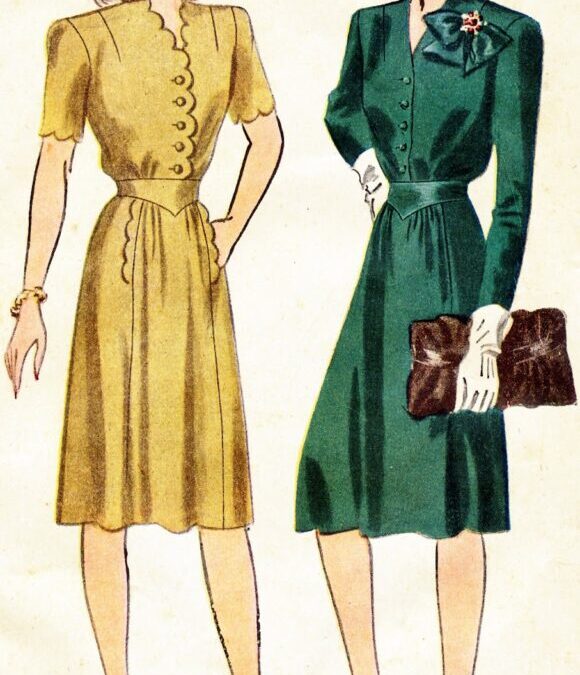
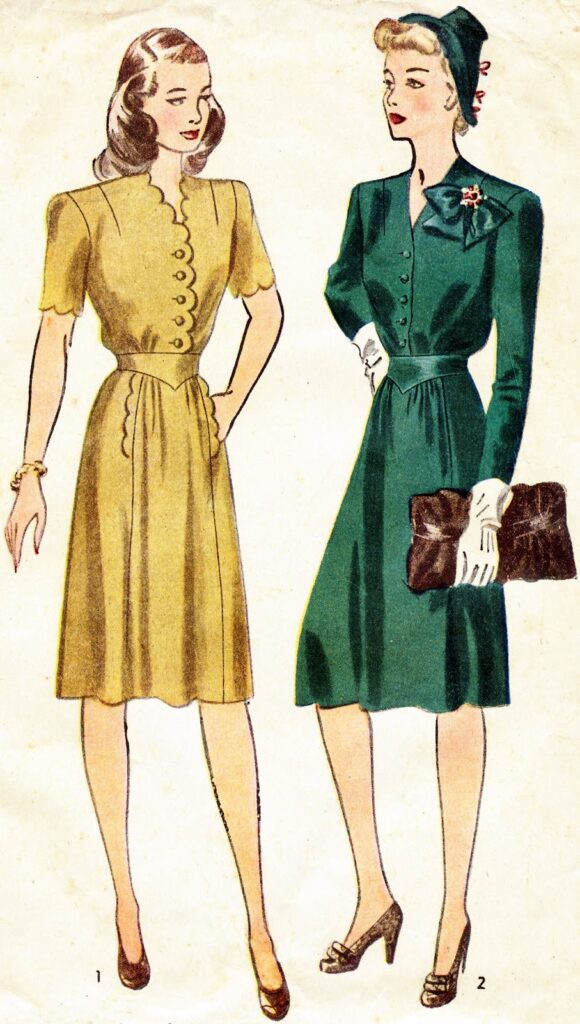
The most obvious stylizations during the first half of the decade was the adaptation to little material. Skirts were almost all A-line, up to the knee. Waists were fit high and as small as possible. There was a slightly masculine look to tops. Every top seemed to have shoulder pads and a square cut. And red lipstick was on every woman.
Everyday dresses tended to be rayon or cotton. Their sleeves ended just above the elbow and could be puffy or straight. The shoulders were padded lightly. The skirts of the dresses were the simple A-line cut. Dresses were often solid, in patriotic colors, or with large prints. Necklines were quite modest, with laces and bows around the collars.
As many women were going to work, suits became popular. Made mostly of wool, they were harder to come by. The soldiers needed the material first. The advantage of suits over dresses, in addition to the professional look, was that two suits could become four looks, when mixed and matched. Suit skirts were neither straight nor gathered nor pleated. Jackets were longer than previously, reaching mid-hip. When buttoned, the jackets could be worn without a blouse, just a scarf for color. Boleros became more popular. These were shorter jackets, without buttons. A blouse or dress was worn with it.
Blouses, worn with suits or with a skirt, only, usually were buttoned down the front. Necklines either were V-shaped with lapels or a Peter Pan collar. A cardigan was sometimes worn with the blouse rather than a jacket.
Shoes were plain and chunky. Leather went to the soldiers. Women wore velvet, mesh, reptile skin and wood. Early in the decade the short thick heel was popular. Later the heel became thinner. This is when the wedge came out. It was pronounced to be safer than pumps. Maybe it was. Maybe it was just a popular option. Many of the shoes had peepholes at the toes, a stylistic choice. It had become too expensive to put designs in the shoes. As summers were seen as relaxing times, slip in shoes made a presentation. Loafers made their entrance among teens and working women at this time.
Coats for warmth were plain, square and to the knees, in the early 40s. They buttoned down the front and had narrow sleeves, which may or may not have had cuffs. Fur trim was still a popular option.
Swim suits were more popular than ever. Most were one piece, but the two piece was designed and worn. The tops were only 4” from the waist of the bottoms. Bottoms were skirts or like shorts, along the thigh. Beachwear, or “playsuits” were considered modest wear over a swim suit when away from the water. These were button-down; loose-fitting short outfits. These became the prototype for outfits of the 50s and 60s.
Head coverings were still de rigor for outings. Hairdos had grown long, again, and many wore their hair down. For safety at work, women wore their hair pulled back into a snood. It became a popular hair decoration. Hats, turbans and scarves were all worn in the most stylish of ways. Most hairdos were arranged so that they would look good with and without hats. Of all the looks most popular in the decade what stood out the most were the beret, the turban and the small hats with flat brims and small facial veils.
Accessories were still very important to the dress of the lady. Gloves were still worn for any semi-formal affair, like visiting or church. The gauntlet mid-arm length glove was the most common. These were plain, not lace or embroidered like previously. They were worn in neutral colors, matching one other accessory.
Purses were larger than in the previous decade. Women needed to carry more items, like office supplies and cosmetics. The purses were made with rushing and scallops. After the war, when women had more discretionary money, they bought purses in bold colors and geometric shapes.
The jewelry of the era was large, chunky and colorful. Much was made from the new plastics which came from research for the war. With the fewer clothes, these big pretty items looked cheerful.
The women clung to the concept of the ideal shape, wide shoulders, narrow waist, luscious hair. The trick of the shape was in the undergarments. Bras were large with full backs. They probably held the posture of the back better. Girdles, those awful creations, held hips from jiggling and waist tucked in. Slips were worn to keep a smooth look. Stockings were more comfortable than bare legs. They had seams up the back, which were required to be straight, and were sometimes difficult to keep so. Garters, the clip style by then, held the thigh-high stockings in place. Seams were common into the 50s. I remember!
Despite the boredom of the styles, the 1940s were a great decade to live through!
In another of a continuing series of sagas of our foremothers, today we discuss Grace Robbins.
Grace, daughter of Arthur Neale and Grace O’Hara, was probably born in Brackley, Northamptonshire. But her true home seems to have been Dunluce Castle in Ireland, where her mother supposedly was born. She was a cousin of Admiral James Neale, who would be a favorite of King Charles I.
At the age of 15, Grace was taken to Virginia aboard the Diana, with Sir George Yeardley. They arrived in 1618. Within a few years, Grace had met and married Lt. Edward Waters, her elder by 14 years. They moved to Elizabeth City where Waters had patented several hundred acres of land. During the disastrous Good Friday 1622 Indian attack, both Grace and Lt Waters were captured by the Indians. While the Indians were celebrating, Edward, a military man, found one of their canoes. Luckily, the couple was not tied up or well guarded. The two stole the canoe and made their way to Jamestown.
Apparently, the couple spent some time in Blount Point, in what is now Newport, Va., before going back to their land in Elizabeth City. Their son, William, born 1623 is recorded as being born there. However, by the census, or muster, of 1625, they were home. A child was born to them that year, Margaret.
Several years later, Lt. Waters visited England, where he died in August 1630, leaving Grace with two small children. After several years, Grace met the widower Obedience Robbins and his . They married. William, older, now, probably went to England for university studies.
Obedience Robbins, a trained surgeon and planter, had been in Virginia since 1628. When they married, they moved to his land on the Eastern Shore, some of which he was granted for bringing people over, including himself, Grace and Margaret. During the next ten years, Obedience and Grace had five more children. Dorothea, John, Obedience III, Mary and Frances (who probably died young).
While Grace handled the plantation management, Obedience, who apparently did not serve in a medical capacity, was politically active. He had already served as burgess in 1629/30 and in quarter courts in the early 30s. Grace was used to this, since Lt. Waters had been in a similar position.
Although Robbins still held offices while getting married in England, he apparently seemed to need time off with the rapid coming of children. He was not as active in politics in the late 1630s, except as a member of the church council, or vestry. However, he did host the “laughing king”, the Indian chief, who came to visit every year in the spring. His and Grace’s hospitality was questioned on various occasions, even bringing the question into the courts, but hailed on others.
Grace had to have had great patience, since Obedience and their neighbor, Edward Scarborough, had great enmity for one another throughout their lives. They argued about boundaries of their own and boundaries of the counties. They argued about the treatment of the Indians, with Obedience being welcoming and Scarborough killing them. It only ended with the death of the men, just a few years apart.
Throughout the 25 or so years of their marriage, Robbins held land which he rented out, grew tobacco, which he sold and had means of transportation, mostly boats, which he rented. They lived on Cherrystone Creek, not far from the Chesapeake, where trade flourished. The family did well.
The Robbins did well for their children, too. Obedience’s daughter, Margaret, married Grace’s son, Col. William Waters. Their other children married into the most prominent families, like the Scarboroughs.
When Obedience died in 1662, Grace inherited a large, well-functioning plantation. Her remaining children and grandchildren inherited it when she died twenty years later.
Men’s clothes have not changed as dramatically as women’s clothes over the past century. Here’s the scoop on the variations for the decade of the 1910’s.
Hairstyles were modified pompadours in the early years of the decade. As the war rolled around, and then the boys came home, they started sporting more easy-care hairdos, short, slicked back, or to the side. Whiskers and mustaches were still seen in 1910. But as the years continued, the young men started emulating the military requirements and facial hair generally disappeared among them. Older men clung to their older styles. So, if your young hero just returned from the Front, he isn’t going to be twirling his long mustache.
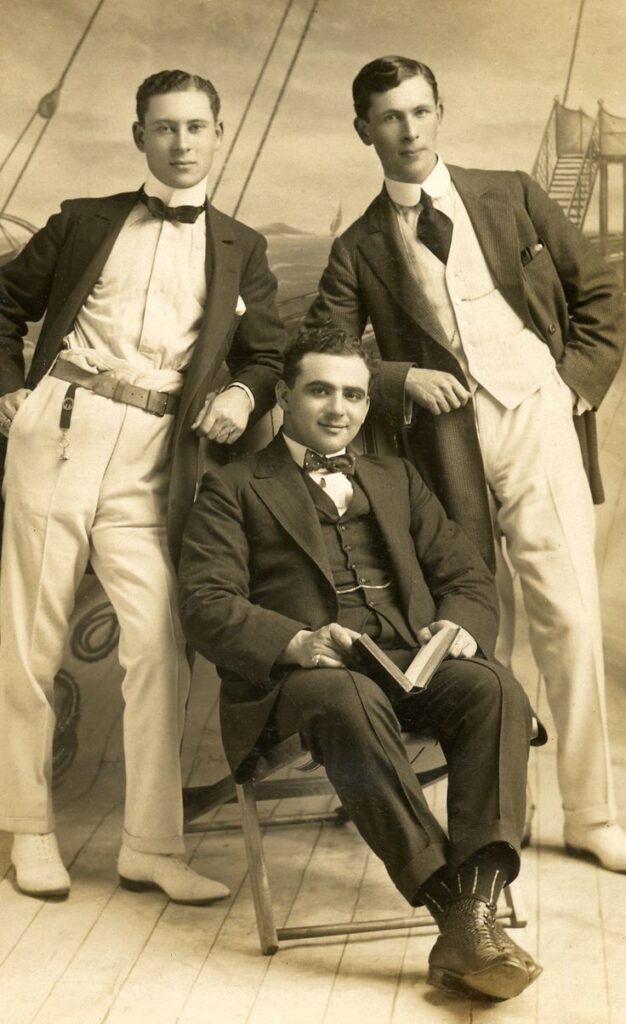
Among businessmen and professionals, the suit was the choice for day wear. They were called sack suits, even in the ads, the reason being that they were baggy. The early years of the decade, the sack suits consisted in a long, plain loose-fitting jacket, 30-32” long. This made them end at mid-thigh. The lapels were a standard 2.75” wide. There were 1-3 buttons. The winter colors were dull, dark navy, grey, green or brown. Any striping, checks or plaids were hints, rather than obvious. Summer colors were light grey, tan and off white. The jacket edges were straight edges or slightly rounded at corners. The pants for the suits were high-waisted with straight legs sporting a crease both front and back. They were cuffed at the ankle. Suspenders, either elastic or leather, were used to hold them up. Belts were used for sporty clothes, only. Suits were accompanied by collarless vests with 6 buttons. Before the war, the vest was cut low enough so that it was not seen when the jacket was buttoned. After 1914, the vests took on more prestige and were cut higher.
After the war, the young men returned with their own tastes. The material was more colorful, the look more tailored with a defined waist. Shoulder pads were gone, the jacket hem moved up to mid-hip and showed off large patch pockets. Materials were lighter. The extreme version was called the jazz suit. It had tight shoulders and waist with three closely placed buttons. The pant legs ended above the ankle. It was a strange name to give the suit, seeing as it was too tight to dance in. The materials changed too, making the suits lighter in weight. Light wool was not the only choice. A new cloth had been developed called Palm Beach cloth. It was a tropical weight mohair-cotton blend which was washable and comfortable to wear. The suits came in cheerful colors like lilac and sky blue, checks, windowpane and stripes.
Like today, men wore dress shirts with their suits. These shirts were in pale colors or stripes. Detachable collars were coming in celluloid, for high stand versions. Attached collars came in pointed and round versions.
Coats were more popular then, than now, probably because there were no such thing as heated cars, yet. Every gentleman had a coat, or three. One of the most renowned coats of the era was the duster. Designed for driving in a dusty open car, these coats were popular with the young men. Ankle length, with side buttons, they came in gabardine, twill, duck and Palm Beach cloth. They were either white, light tan or lemon.
The heavy coats for gentlemen came in several different styles, all wool, all knee-length or longer. They were made of wool, melton or chinchilla weave, and lined with heavy cloth or fur for warmth. The Chesterfield was a plain coat with a velvet collar, looking very gentile. The ulsterette had a cape over the long sleeves, narrow lapels and collar. It could be made with lighter material, too. The Inverness cape coat was similar to the previous, but without sleeves. The suit coat sleeves were shown below the caped shoulder. Some materials could be rubberized for rain protection, or oil cloth could be used.
Working men had to have specialized work jackets. Some jobs were outdoors. Oiled or waxed cotton coats and pants worked for rain gear. For warmth, there was a reversible leather and corduroy double-breasted jacket fit to just below the hip. There was also a sheepskin-lined corduroy or moleskin jacket which could be waist-length to knee length. The well-known Indian blanket plain mackinaw was very popular and has continued to be so to this day. The reefer coat (now known as the pea coat) was longer and, thus, warmer, than the jackets.
Footwear was of three types: boots, business dress shoes and pumps (yes, that is what they were called for men). Boots, used for travel, business and labor, were a few inches above the ankle. They were usually attached by a combination of laces and hooks. Some were two tone. Heels were not flat like typical boots today, but had a height of 1 ½”. For business, men could also wear shoes, cut high on the foot, mostly single tones like brown, black patent leather, gunmetal or white. They were very plain, with broguing (cut out patterns) for country wear only. The heels were 1 – 1 1/2” high. Formal pumps did, indeed, look similar to women’s pumps today, cut very low with a heel from 1 – 2” high. Laces were made of ½’ wide silk with metal covered tips, which tended to rust.
Accessories were common among men at the time. Pocket watches were very obvious until 1914, worn in a vest pocket with a chain that fit into a button hole. Then wrist watches came out. As is typical, the young men wore them first. All gentlemen wore gloves. Leather and suede were most common in the winter, cotton in the summer. The colors could be white, grey, tan or matching the neckwear.
The type of neckwear worn depended on the time of day. Cravats or large bow ties were for daytime. Narrow bow ties were for evening wear. Dark long neckties showed around 1914.
Socks were mostly black or grey wool. They were valued as difficult to produce, so they were cared for and mended as needed. Dress socks for the wealthy were cashmere, sild or cotton and might be embroidered. Being as there was no elastic in socks, men had to worry about them bagging around the ankle. So, they had elastic or leather sock garters at the upper calf where the socks were attached. Those who did not have much, like workmen, had drawstring cords at the top of their socks to tighten around the calf.
The hats of the Edwardian age, the derby the top hat and the homburg, were mostly gone after the war. The young men coming home from the war wanted color, not black and brown. They chose the fedora, with its grosgrain ribbon, flat caps in many colors, or straw hats, like boaters. The Panama hat, a new kind of weave, though expensive, was very popular.
The men looked good throughout this decade.
Book 1 of Hadley Sisters Mysteries in ebook and paperback now at Amazon
The “Belle Epoque” is a nickname for the 40 years or so ending with the Edwardian era. That was the reign of King Edward of England, the son of Queen Victoria. He reigned less than 10 years but is famous for that short, elegant era. The epitome of high society and the destruction of said society were all contained in that generation.
The Gibson girl was the design of the “ideal” woman in the 1890s by cartoonist-fashion artist Charles Dana Gibson. He claimed his pictures were the synthesis of thousands of American women. These women were presented as tall, willowy with an S-curve to their spine, thrusting out their top halves, via corsets, to present their femininity. The style stuck for almost 20 years. In addition to the pompadours, the upswept hair of each Gibson girl, which became more exotic with the years, and the hats, which became more unwieldy, the dresses became more elaborate. The first half of the 1910s decade was a celebration of ostentation.
The socially prominent woman was obligated to change dresses four times a day. The morning outfit was usually a plain dress or morning suit. Then there was the afternoon dress for lunch. The casual dress, of cotton or linen, was for afternoon tea and the evening gown, often of silk, for those formal dinners. The woman who had to change that many times needed different under garments for the various fashions. No wonder she needed a ladies’ maid to help.
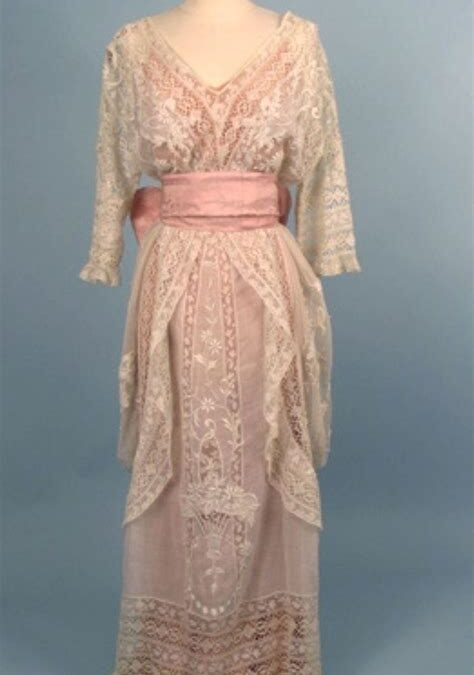
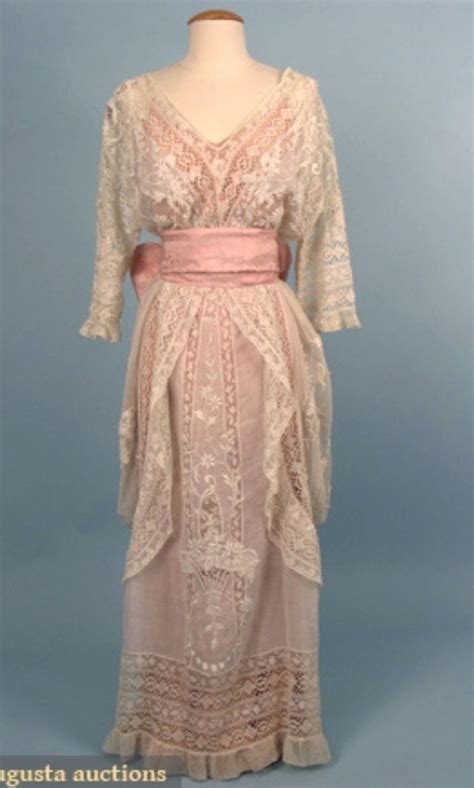
The accent at the beginning of the decade was on pretty, petite and sedate. That meant delicate pastel colors, or whites, with laces, ribbons and feathers. High waisted, or Empire-waisted dresses were the mark of the first few years. If a dress or tunic top had a V-neck, a blouse was worn underneath. Tunics over long, straight skirts were very popular. Jackets and ties were even introduced into business attire, but with skirts And corsets continued the stilted Gibson girl look with the limited movement. Waistlines started high then gradually lowered throughout the decade.
High necklines and longer sleeves were the requirements for daytime. For evening, a sleeveless gown was accompanied by a shawl draped around the shoulders and elbow-length gloves. The designers went crazy with gossamer and peculiar dyes for various effects.
The skirts in the first half of the decade were to the top of the shoe. The second half of the decade saw a shortening to mid-calf, for the first time. Skirts were losing their fullness and tended to be straight, with dresses columnar in shape, also losing the waist definition. The “hobble” skirt saw a brief surge of popularity around 1913-1914. But the hem was not conducive to walking. Pleats and slits were brought in to help the woman get around. Every year the styles changed as if in a surge to be ahead of the common people. The styles went from columnar to waisted to columnar again.
The trend was towards simplicity by the beginning of the war. Women had to get out and work the jobs the men left behind. They needed comfort and flexibility to do those jobs. The styles became simpler to wear, and to put on. Even the high society ladies followed the innovations, empathizing with the workers. Colors got darker, earthier, like copper, navy and greys, in keeping with the somber times of the Great War. Corsets were eliminated by many to free up movement. The waist-less outfits did not need them.
Sports for women had opened up. Women could play both golf and tennis, wearing white skirts to below the knee, white sweaters, blouses and stockings. And, thanks to Keds, they had white sneakers to make movements easier.
Swim outfits existed, but they were bulky. Made of wool, a woman had a dress to just above the knee, clingy pants (or footless stockings, not unlike long johns). These outfits sucked in water and were not very practical, since they would sag when wet.
The middle-class women, those most likely to be in the factories, especially clothing manufacturing, wore basic shirts and skirts to work, saving the dresses til Sunday.
Everyone, who could, wore hats when they went out. The large hats, with voluminous decorations were very popular for several years. Winter and fashionable hats were decorated with feathers and beads and were made of wool felt, straw or fur. Then, the war got underway. In keeping with the new style of simplicity, the hats began to shrink in size and décor. Straw boater hats became popular in the summer. Small brimmed hats, decorated plainly, were worn in the winter.
As long as skirts stayed long, the typical feminine boot, which looked like a pump over white socks, was worn, except for evening wear. But, once the skirts rose, showing ankle and some stocking, the shoes took on the look of today, looking similar to pumps.
Next time we will talk about men's and children's styles from the 1910s.
Book 1 in the Hadley Sisters Mysteries. Available now at Amazon in paperback and eBook


Recent Comments