The second decade of the twentieth century was one of glamour, glitz and societal norms. English and American styles were dictated by the style dictators in Paris. This ended with the Great War. Society changed in those four years. Life changed. It would never look the same, again. And neither would the styles women wore.
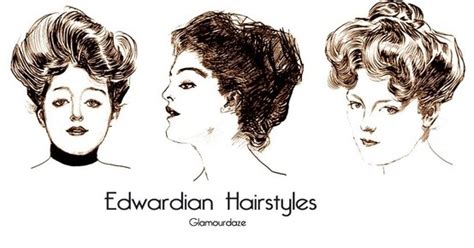
Hairdos were, literally, over the top. Exaggeration to please and impress was extreme. Hats and accessories for the head never were so excessive. Hats grew larger and larger through the early 1900s until the war began and the balloon of enthusiasm for ostentation was burst. Hats returned to normal size quickly. Hairdos became part of the hat for a few years, spreading horizontally with a flat crown on which to place the hat. Luckily, that trend did not last. The women had so much hair and hat that, going to a matinee, they would be asked to remove their hats so that the people behind them could see the screen, or stage. The hats were so big, the hat pins could be 14” long.
The common pompadour was hair piled high, curved away from the head. The hair was back combed and rolled, often, over a rat (a collection of matted hair kept together with netting or other items) or over a wire frame. Back combing could be used to form a matted foundation, with the outer layer of hair brushed over the whole. The hair could then be swept into a bun or chignon. It could be presented straight or curly, with soft curls or frizzy. A cartwheel hat style was one in which the hair was styled to the sides, instead of up, with rats in place to support the hat. The collage loaf was a pompadour with a bun at the crown. Oh, where did they find the rats? Waste not, want not. Women cleaned the hair out of their combs and collected enough to form the rats. The interesting thing is that the ears were mostly hidden in these years. The hair was too important to share with anything.
Evening hairdos were designed for use without a hat. The styles began with a pompadour, then, variations were applied. Height at the nape or crown were commonly added with the rats, combs and hair pieces. Marcel waves were very common. These were horizontally placed waves, typically achieved with a Marcel tong, a curling iron that was placed in the fire before use. Hairbands, flowers, ribbons, metal décor…all were added to enhance the look.
Little girls often, wore their hair down or in braids for the middle class. Teens tended to plait their hair into one braid, tucked up into the nape and secured with an oversize bow. For formal dinners, they would put their hair up. It needed quite a bit of practice. Young ladies would not wear their hair down once they were “in society” around age 17.
Around 1909, the Bob, or short haircut, started being seen in the avante-gard circles, mostly in Europe. These short hairdos were supplemented with false buns or curls as events required. It did not reach its heights of popularity for another ten or twelve years.
The Great War began in the summer of 1914. An almost immediate change in hair styles showed up. Ribbons and flowers in the hair gave way to more austere, demure looks. The pompadour and rats were still there, but the effect was more sedate with fewer feathers, jewels and height. And, as the decade progressed, the hats and the hair became simpler. By the end of the war, hair was less complex and getting shorter. Most hats were small-brimmed and simply decorated. Times were changing.
The outfits men have worn in the past few hundred years have been an advertisement of their class and job status. The 1920s was no exception.
Workmen often had to wear specialized clothing especially when working on motors and fast-moving machines. These could be uniforms, long coats over regular wear or heavy-duty material. Laborers and workmen wore work shirts that were very similar in style to dress shirts except they were often made of heavier cotton, flannel, wool or chambray and had two breast pockets rather than one. Most often they were made in solid colors, except for the plaids worn in winter. The pants worn to work often had bigger patterns, wider stripes or more colors than the materials of suits. In the winter the pants were made of wool, moleskin (a very tight weave cotton) tweed and corduroy. The spring/summer season saw the men in flannel, light wool or duck cloth (a light canvas). Denim was used for overalls and work pants that factory workers or farmers would wear. Holding up the pants were leather suspenders that buttoned on, and belts. Most workmen wore sturdy lace up boots made of horsehide leather. Cold weather mostly saw the workmen in leather “lumberjacks” or plaid mackinaws, both being short but very warm jackets. On their heads, most laborers wore caps, wool in the winter, linen or poplin in the summer. You did not often see a mackinaw with a fedora.
The majority of men in cities were dressed fashionably, however. It was a classic, sophisticated look, with a touch of clever fun in the accents. This means, for daytime, a three-piece suit, jacket, vest and pants. All matching. With a tie, dress shirt, socks and shoes. Even teens and college men dressed as well as they could even if it meant wearing hand-me-downs or unmatched vests.
Suits, for winter, were made of wool tweed, mohair, wool flannel or corduroy. Colors were the more traditional browns, medium blue, dark green and grey with pastel stripes. Patterns were in bold plaids, checks and windowpane check. Summer suits were made of lighter wools, linens and cotton seersucker. The colors were lighter, too, ivory, white and pastels (like lilac!) The jackets were mostly single breasted with three to four buttons and two flap pockets, until slit pockets were made in the later part of the decade. Rule of thumb was that the top button was over the heart. Vests, with or without collars, were cut to be completely hidden behind a buttoned jacket. The cut of jacket and pants was snug and slim in the early part of the decade. Then, as the economy grew, the pants and jackets both got boxier, with pants eventually having a 10-12” circumference at the hem. Jacket lapels were a big fashion item, growing bigger with every season. The notch lapel was the customary one for years, but towards the middle of the decade, the peak lapel began to show itself. The pants came pleated or flat, with slit pockets on the side and one welt pocket in the back. Pants fit high to the natural waist, fit loose at the seat and hips and fell to the top of the shoe, no longer, so as to avoid buckling at the ankle.
There were tiers of business and casual dress. A slightly more casual summer look was the all-white or the white pants and navy jacket ensemble that the college boys wore. These were accessorized with a captain’s hat and white or two-tone oxfords. A variation was a jacket striped with the colors of the organization or school colors worn by sports figures or spectators.
The black pinstripe double-breasted suit, assumed to be worn by gangsters in the 20s, didn’t really exist. This was just a Hollywood gimmick to instantly identify the “bad guys”.
What did men wear for evening wear? There were various degrees of formal wear. The tuxedo with tails, a satin stripe on the pants and wing tip collar was what one wore to theater, upscale restaurant or night club. White tie and vest was more formal than black tie and vest. In the mid 20s, the tuxedo jacket made its debut. It was more comfortable than the tails. A morning suit was worn for formal day time wear. This consisted in black tuxedo jacket, grey striped pants, buff or ivory or black vest, a bowler and spats.
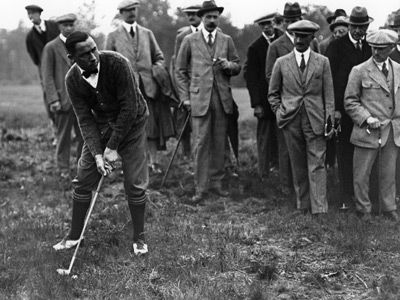
Little boys did not wear long pants. And neither did golfers. They wore knickers, just below the knee-length pants that were full and gathered into a cuff. Socks going up to under the cuff completed the pant look. Most wore sweaters, shirts, ties and caps to complete the look, boys and men. Tennis and cricket players dressed similarly, but tended to wear all white.
Sweaters became popular after the Great War. They were affordable and had a fun look. There were pull-overs and button downs, high shawl collars, turtle necks and V necks. All but the turtle necks were worn with dress shirts and ties.
Shirts were very similar to what men wear today. They were mostly vertical stripes early in the decade and solids in most colors later. Collars were round-tipped, pointed, with a 2.5-3.5” length or button-down. You occasionally saw the stiff linen removeable collar, but mostly on old men. A white collar and cuffs on a different color shirt was almost exclusive to the 1920s. The biggest problem with ready-made shirts, which was quite common by then, was that they came in neck sizes only. No sleeve lengths, no torso considerations. So, many men got longer sleeves than they wanted. To avoid getting sleeves into the soup, or the ink, men wore arm bands made of webbing to hold up the sleeves. This stayed for several decades as a style.
Ties went with all shirts. Very full bow ties in stripes and polka dots, Art Deco or paisley silk neckties, or knit ties with fringes: these were the looks of the time. The ties were short, ending several inches above the waist.
The most common winter coat was a long, loose heavy wool with wide lapels. Rich men sported fur collars for warmth. Trench coats were common in wet weather. The big fad of the decade, for all the college men and coeds, was the raccoon coat!
Men always wore hats. Laborers and sports figures wore caps. In the winter, they were wool, corduroy or tweed in blues, greys and browns. In the summer they were linen or cotton poplin. The interesting thing about caps is that they did not have to either match or coordinate with anything else the person was wearing. Other hats, straws, homburgs or fedoras, had to coordinate with the rest of the outfit.
Mens’ shoes were boots until after the war. The low-cut oxfords came in single colors. Wingtips were the fancy dress shoes. Black patent leather was strictly an evening shoe.
Once low-cut shoes replaced boots, the socks began to show. Crossing a leg made them show quite a bit. These became colorful and patterned. Since there was no elastic in socks until much later, men wore elastic garters to hold up the calf-length socks. These socks were argyle, striped or solid.
Accessories for men included gloves, like unlined driving gloves, in an array of colors, pocket squares which coordinated with ties, collar pins to keep the soft dollars from bending, spats, to keep the shoes clean, pocket watches, and walking sticks.
Accessories were the top of the fashion list for the ladies of the 1920s. With so many dresses made from such similar patterns, the fabrics and the accessories made all the difference.
The most important accessory was the hat. And the most important hat of the decade was the cloche. This hat was a soft helmet-shaped item with an all-round brim fitting low on the forehead. It could be plain or decorated with embroidery, beadwork or flowers. The hats were made from felt, quite often, but also silk, satin and straw. For evening wear, the exotic turban was worn. The material for this had to be light; having one’s head bound for hours can be very unforgiving in a crowded place. The turban was decorated with feathers, pearls, flowers or feathers, producing an unusual look. The beret became more common, too, used primarily with sports clothes.
Stockings became a more prominent feature in this decade. For the first time, women had to worry about what their legs looked like above their ankles. House dress stockings were usually black cotton. Afternoon dresses deserved better. The stockings were most often silk, in white, black and tan for day and nude and pastels for evening wear. The sheer material was held in place by garters. And a lady had to be aware of the seam being straight all the time.
And what was on their feet? Shoes of quality. Flat oxfords were worn at home. Going out shoes were 2” heeled oxfords, Mary Janes or T-straps, some decorated with rare leathers, like alligator or snake, or with contrast stitching or cut-outs in the leather. Evening shoes were the Mary Janes or T-straps with glitter or sparkles. And, for the first time, a sport shoe was developed for women, canvas sneakers.
Gloves were a basic accessory, like a hat. During the day, a woman wore wrist-length white gloves, kid or cotton. Evening gloves were opera-length or elbow length, again kid or cotton. The very modern flappers could wear lace gloves to the night clubs. In the winter, gloves were worn for warmth, thus, knitted gloves or fur-lined leather.
Shawls, scarves and filmy jackets dressed up a simple outfit in various ways. It was inexpensive to add those to a working girl’s repertoire of accessories. Long and narrow, squares with fringe, satin or chiffon, every item made a sure hit.
There was only one rule with jewelry: colorful. Rings, hairpins, cuff bracelets and dangle earrings were all popular. Most were oversized. Chokers were embellished with bead work, and embroidery. Large pins were attached to shoulders. Art deco earrings swung from lobes. The pearl necklaces that fell to the natural waist were the rage.
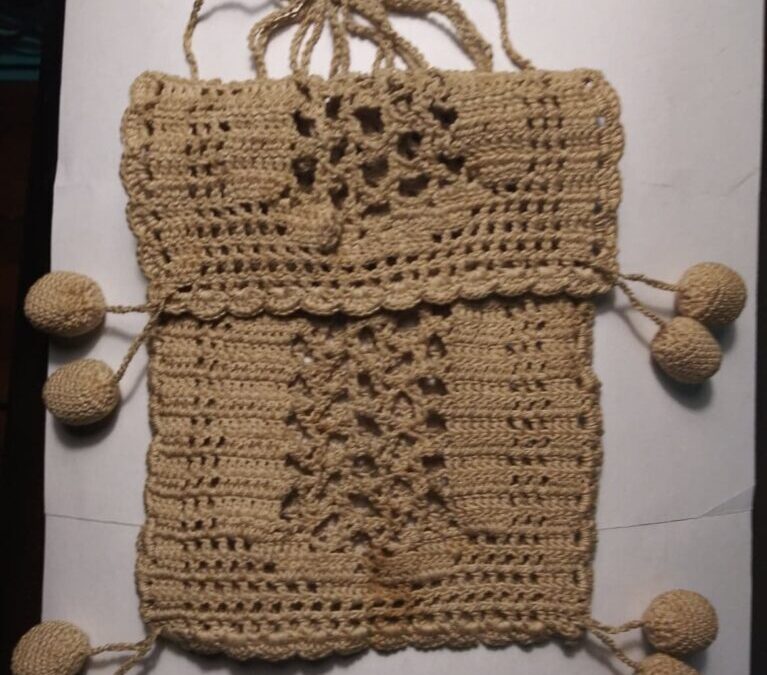
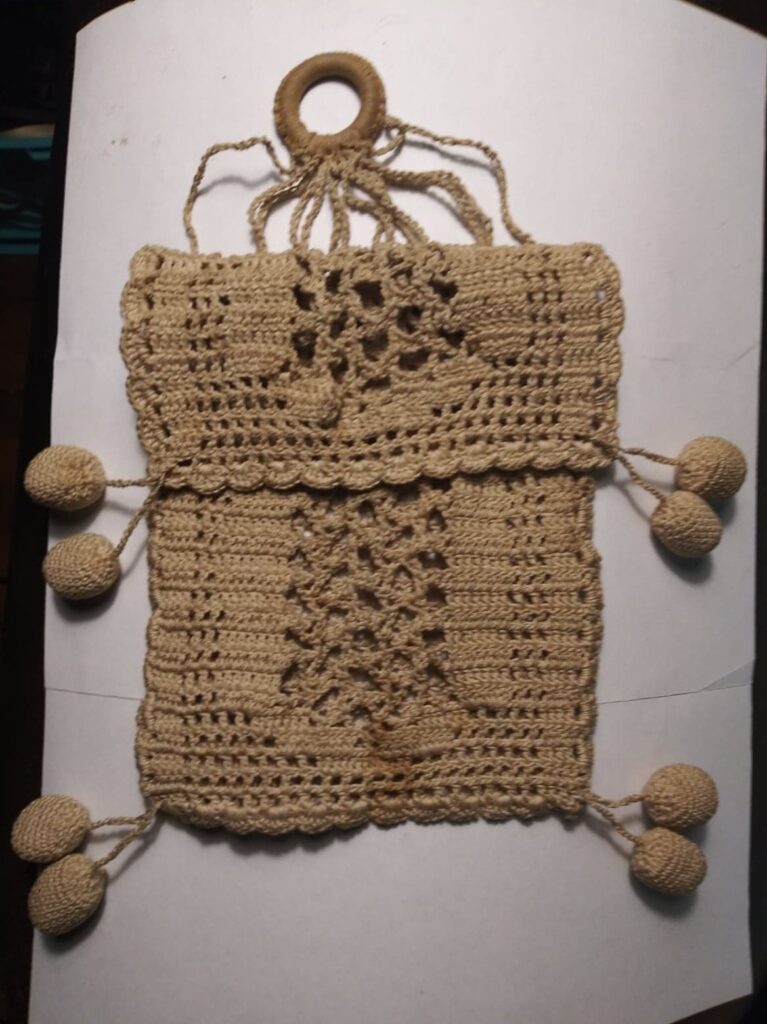
Avoiding the feminine handbags of the past, the ladies of the Roaring 20s needed something to hold their omnipresent compacts. Small hand-embroidered or crocheted purses were popular. They were just large enough for a change purse, a handkerchief and the compact. Powdering your nose at the table was a very popular thing to do, apparently. For those who thought that was too much, manufacturers made cosmetic cases into very artsy displays with a chain to hang on one’s wrist.
Glasses had been avoided by as many as possible, especially among the young, for years. Finally, a process was created to make the first plastic frames. The colors were black, brown or tortoiseshell. It gave a whole new look to the nearsighted. The frames were round, due to the limitations of manufacturing the lenses, but it was so Modern! Of course, metal was still a popular look, too. Once larger frames were available, the Hollywood stars all started wearing sunglasses, giving a boost to the optical industry, because, of course, the movie-addicted populous imitated their heros and heroines.
The cosmetic industry had a great awakening in the 1920s, too. It all began with the Gillette Razor company which had the contract for US military during the Great War. At the end, the men went home and used whatever brand they wanted. To not lose the great sales numbers they had during the war, Gillette saw that sleeveless dresses were becoming popular so they started a newspaper campaign to tell women they needed to shave their underarms. And, so it began! When the silent movie stars began to peroxide their hair and turn into a white-blonde, many women followed suit. They also followed the fad to thin arched brows, dark eyeshadows and a bright red lipstick. The women have been using cosmetics ever since.
Although the hemlines climbed during the 1920s, the winters were still too cold for a coat that short. Today, we discuss the coats the ladies and girls wore in that decade.
At the beginning of the decade, the coats were still long. The coats were down to midcalf, to show off the dress hemlines or to show off the boots. The dresses were just above the ankle and so were the ladies’ warm wraps. The lines of the coats were simple, but all the additional parts, collars, cuffs, buttons, pockets, were oversized and took over the look! The waist was accented with a matching belt more often than not. A popular item for years was the detachable fur collar. Of course, the coats had to be oversized to accommodate several layers of clothes. Remember, central heating was not yet a popular commodity.
By 1923, the hemlines of coats had gone up, then, down, again, to just above the ankle. The surplice coat, or jacket, was the most popular item. This has a look of a man’s coat, with the neckline a deep V. The coat is loose fitting, not usually tight at the waist. This style had subtle trim, contrast stitching. The sleeves tended to be batwing or bell, in shape, for better movement.
The younger ladies, the college age crowd, found a new coat style, based on the men’s trench coat popularity. These coats were a straight-cut, double breasted (6 button) coat which was most trendy in the second half of the decade. They were made in bright reds and blues. Plaids were common in single breasted or wrap form.
By 1925, the coats had risen to the knee. They were most commonly found with a deep V neckline sporting a fold-out collar. A fold-out, or rolled collar, is one that stands up slightly from the point of attachment to the neckline of a garment before folding over to lie flat. They also could have a fur, detachable or not, collar.
The fabrics used for these coats can only rarely be found anymore. They included wool, wool velour, velveteen, plush, tweed or vicuna. This last is a fabric made from camelids, or llamas, found in the Andes mountains. It is absolutely the softest wool known, along with the wool of musk oxen found only in Alaska. You can not find it anymore because the animals defy domestication. It was very fine and very expensive.
Coats at that time came in a variety of colors. Tan, brown, rust, cranberry, grey, black, green, rose and medium blue were the most common. They came in plaids, checks and fancy textured weaves. The linings were most often of a single bright color, very soft and smooth. Everything was decorated with cording, embroidery and other trim.
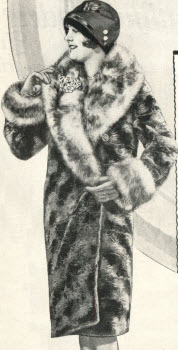
Faux furs and cheap real fur dyed and sheered to look like their expensive counterparts were all the rage. Real fur coats were found everywhere. Everyone had one. My grandmother got a mink coat for her 16th birthday! Any fur possible was used. They came in full length and jacket length. And many of the college kids did. Male or female, the outstanding item of a collegiate was a raccoon coat. It was not worn for warmth as much as for status! Of course, driving in an open car was sure to make one cold, so, what better reason to get the parents to splurge?
Everyone had to have fur! And if you couldn’t afford a real fur coat, there were faux fur coats or cloth coats trimmed with fur at collar and cuffs.
Winter coats were not the only need. Spring coats were worn longer than coats are now-days, since the lack of central heat caused people to dress warmer longer in the season. These coats were a light wool, velour, polaire (an arctic fleece), normal fleece, jersey or a knit. They tended to be an open front with a tie belt. They were more sporty than dressy, but they were worn with everything.
However, on rainy days, the light weight cloth could get sodden in a rain. What worked for men, for years, appeared for women, in brighter colors: the raincoat, often made with rubberized cloth. It appeared for children along the same time. To save the hair and the hats from ruin, raincoats came with matching hats. These looked like a shower cap with a brim, hardly anything we would wear, now, but they served the purpose.
Next time, we will talk about the accessories, hats and shoes of the ladies of the Roaring 20s.
The Great War, women’s suffrage, improved international trade, more thorough education for the masses. What do these all have in common? They all contributed to the most amazing and fast change in culture in many centuries. And one of the most predominant features of that change was the entirely new look for women!
Contributing to the war effort, women, by the end of the war, were seen as intelligent and capable of handling decisions. By 1920, women in the US were given the right to vote. Suddenly, women saw themselves as competing with men on the job front and bringing home their own money. Financial freedom makes one develop social freedom. And many women did. They expressed their freedoms with their styles.
Gone were the days of morning, afternoon and evening changes of clothing. Clothes were now defined by what you did while wearing them: housedresses, going out dresses, evening apparel, sports outfits, etc. One might change several times during the day, but for a specific reason.
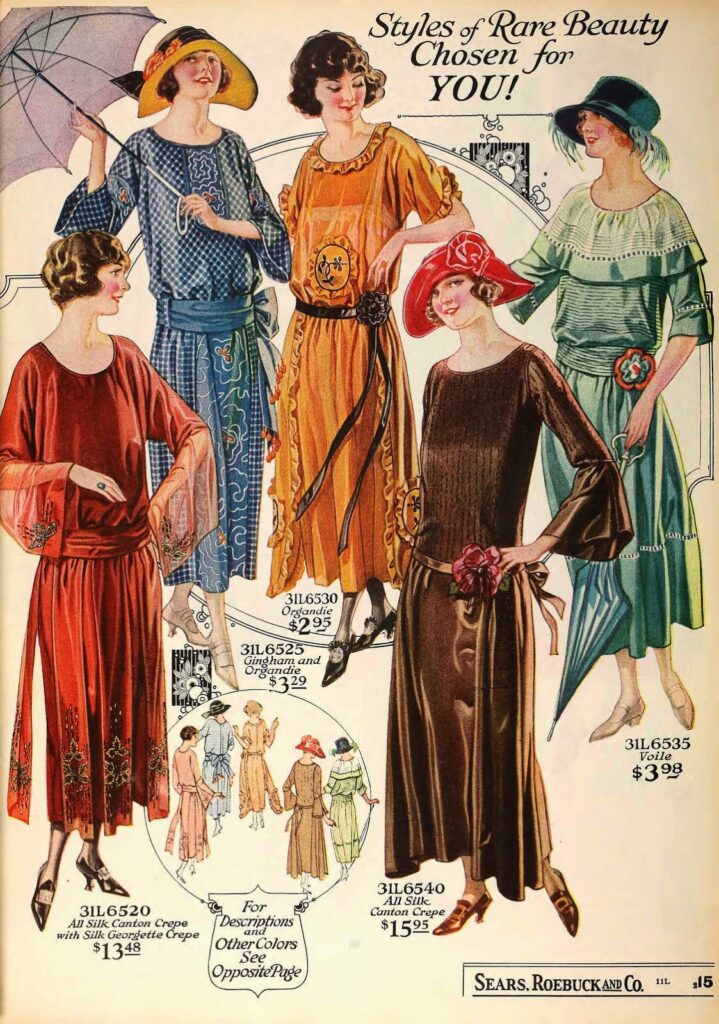
Typically, house dresses were simple, straight cotton or cotton blend affairs, in plaid, prints or colors. They were either not waisted or had a drop waist. They had small white collars or wide, long, flat collars, long or short sleeves. The dresses were often decorated with embroidery, lace or rickrack. They were most often worn with dark stockings and sensible dark oxford shoes, flat or with a short heel. The dresses were very blousy and did not need buttons or hooks. They could easily be put on and taken off, making dressing a very quick affair. Most often the dresses were covered with a full apron while working in the house. Older women brazenly showed their ankles. Younger women had hems above mid-calf.
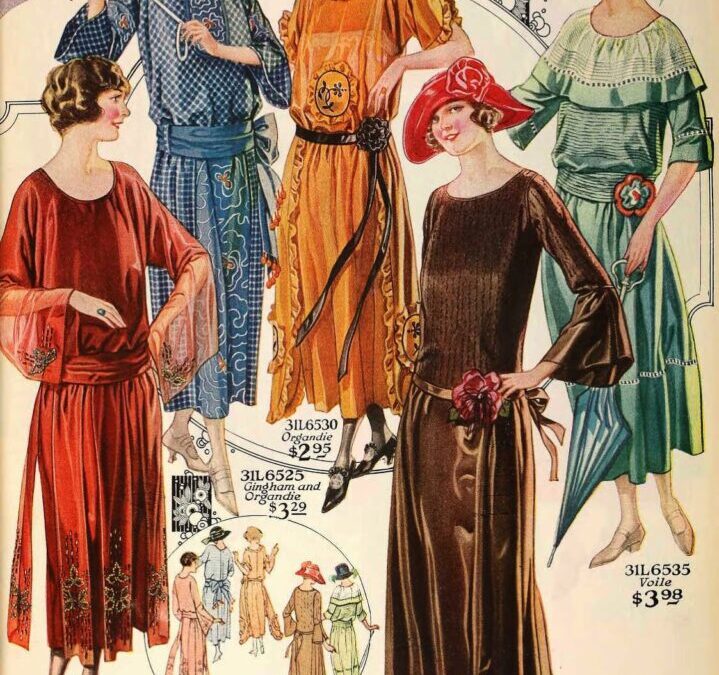
The house dress would never be worn outside the house unless the wearer had nothing else. The ladies dressed to go downtown for errands or to go visiting. The tall, thin look abounded everywhere. And the ease of dress continued with the new “boat neckline”, much wider than the close necklines previously seen in day dresses. Fabrics ranged from casual jersey, batiste, wool, linen, knits, crepe, and rayon to fancier silk, taffeta, organdy, and velvet. These beautifully draped materials can’t even be found in fabric stores. anymore. The material of the garment made a status statement. Dresses with sashed natural waists or dropped waists were worn alone, or with a matching or coordinated long jacket.
The most popular colors for summer were jade, sunset orange, powder blue, white and pale yellow. The fall/winter colors were black, mauve, purple, sage green and burnt orange. City dwellers tended to have muted colors. Country and seaside dwellers went brighter. Solids were more common but there was some representation of polka dots, plaids and small prints. The dresses were busy with pleats, tucks, embroidery, smocking, ties, and belts, everything arranged to accent height. Long sleeves were de rigor, except in the summer.
Hems were all over the place in the 1920s. The straight skirt was hard to move around with. Answers to that problem included side pleats, flounces, tiers of material, bias cut patterns and, the most popular, bringing the hem higher. By 1927, the popular height was just below the knee. It had already started to drop by 1928. That year, my grandmother got married and her mother insisted on the shorter style for the wedding gown. Her mother was a seamstress.
Due to the leg exposure, stockings became an important part of the outfit. They came out in cotton and silk. The silk ones came in white, black and beige. For the poor teens who could not afford stockings except for good occasions, the fad in some big cities, was to paint smile faces on their knees with lipstick. The sales of both stockings and lipstick skyrocketed over the decade.
Jewelry was plentiful and somewhat gaudy, like beads, pins on hats and jacket lapels. Small purses held little. Shoes were heeled Oxford, Mary Janes, or T-straps. I remember my grandmother telling me to keep a quarter in my shoe, for a quick getaway phone call; of course, it was only a nickel back then. Many girls would go out without a purse. The well enclosed shoes could easily hold a coin.

Recent Comments